Java Series #15: Spring MVC
Spring MVC Explained: Model–View–Controller, DispatcherServlet, and Why Multiple Dispatchers Exist

MVC in One Breath
Spring MVC follows the Model–View–Controller pattern:
Model → Data + business logic result
View → UI (HTML via JSP, Thymeleaf, FreeMarker, etc.)
Controller → Handles requests and decides what to return
But controllers don’t receive requests directly.
DispatcherServlet: The Front Controller
The DispatcherServlet is the front controller of Spring MVC.
Every HTTP request enters the application through the DispatcherServlet.
Flow:
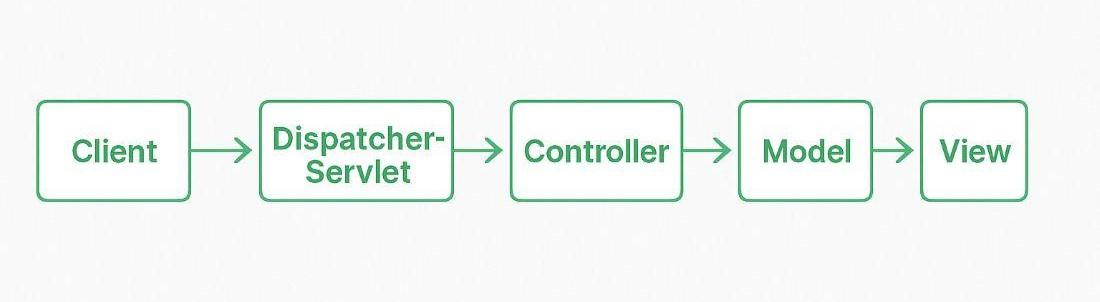
Client → DispatcherServlet → Controller → View → Client
So instead of requests going straight to controllers, DispatcherServlet sits in front and coordinates everything.
Why DispatcherServlet Exists
Before Spring MVC (Pure Servlet Era)
Earlier, every endpoint had its own servlet:
/login  → LoginServlet
/save   → SaveServlet
/delete → DeleteServlet
Why?
Tomcat only understands Servlets
Each URL had to be mapped to a servlet
Problems:
Too many servlets
Repeated boilerplate
HTML mixed inside Java
Hard to maintain
After Spring MVC
Now we have:
One servlet → DispatcherServlet
Many controllers → plain Java classes
/* → DispatcherServlet → @Controller methods
So yes, your understanding is correct:
Earlier, every endpoint needed its own servlet.
Now, a single DispatcherServlet receives all requests and maps them to the appropriate controller method.
DispatcherServlet → HandlerAdapter (What Happens Internally)
Once DispatcherServlet receives a request:
It finds which controller method matches the URL
It uses a HandlerAdapter to invoke that method
It processes the return value (Model, View, JSON, etc.)
It resolves the view and sends the response
You don’t call HandlerAdapter directly — Spring handles it internally.
Controllers Are NOT Servlets
This is a key distinction.
Controllers do not extend
HttpServletThey are just annotated Java classes:
  @Controller
  @GetMapping("/save")
The only servlet involved is DispatcherServlet.
View Layer in Spring MVC
The View is responsible for rendering UI.
Common view technologies:
JSP
Thymeleaf
FreeMarker
DispatcherServlet doesn’t render views itself — it delegates that job to a ViewResolver, based on configuration.
WebApplicationContext per DispatcherServlet
Important architectural detail:
Each DispatcherServlet has its own WebApplicationContext
This means:
Separate controllers
Separate view resolvers
Separate interceptors
Separate MVC configuration
They may share a parent (root) context for services and repositories.
When Do We Need Multiple DispatcherServlets?
Most applications need only one.
Multiple DispatcherServlets are used only when you want strict isolation between web modules.
1. Different URL Spaces, Different Responsibilities
/admin/* → AdminDispatcherServlet
/api/*   → ApiDispatcherServlet
Why?
Admin UI uses JSP or Thymeleaf
API returns JSON only
Separate configs stay clean
2. Different Security Requirements
/admin/*  → heavy authentication, RBAC
/public/* → open endpoints
Each dispatcher can have:
Different interceptors
Different security rules
3. Multiple Products in One Deployment
/productA/*
/productB/*
Each product:
Its own controllers
Its own views
Its own web configuration
4. Legacy + Modern Codebase
Common in enterprises:
Old XML-based MVC module
New annotation-based module
Instead of rewriting everything, teams isolate them using multiple DispatcherServlets.
Different View Technologies per Dispatcher
Example:
/web/* → JSP / Thymeleaf
/api/* → JSON (no views)
/admin/* → FreeMarker
Each DispatcherServlet:
Has its own
ViewResolverAvoids configuration conflicts
What Multiple Dispatchers Are NOT For
Performance, Scalability, Load balancing, Microservices
If you’re thinking microservices → separate applications, not multiple dispatchers.
Spring Boot Reality
In Spring Boot:
DispatcherServlet is auto-configured
One dispatcher is the default (and recommended)
Multiple dispatchers are rare and advanced
Final Mental Model
Servlet → low-level HTTP handler (Tomcat understands this)
DispatcherServlet → Spring’s smart servlet
Controller → request handler logic
View → UI rendering (JSP, Thymeleaf, FreeMarker)
Multiple DispatcherServlets → used only for strong modular isolation
About the author
- I’m a Full-stack Developer who enjoys turning ideas into simple and useful experiences. I like building clean user interfaces, exploring AI, and understanding how things work behind the scenes. From creating websites to trying out new technologies, I’m always curious and learning something new. Next.js, Node.js, MongoDB, and Java Spring Boot are the tools I use regularly. I enjoy experimenting with projects, sharing what I learn, and improving with every build. Vibing + Thinking.
Comments
Join the discussionNo comments yet. Be the first to comment.


